In the Laurentians, choosing between an artesian well installation and a water catchment system is not just a matter of personal preference. It is a choice that depends on the land, site access, budget, available water source, and the real constraints tied to the property. When you think about a home or cottage in an area like St-Donat, Ste-Agathe, or Tremblant, you want a reliable, durable solution that is well suited to the local reality.
Between a wooded lot, a residence perched on a sloped property, a cottage near a lake, or a more isolated home, the right answer will not always be the same. That is exactly why this topic deserves to be looked at concretely. The goal is not to choose the solution that sounds best on paper, but the one that truly works day to day, summer and winter, in the Laurentians.
Why this choice is so important in the Laurentians
In this region, the terrain, rock, proximity to lakes, possible drilling depth, and available space around the home change everything. What works perfectly for a property on flat land may become much less logical on a steep or hard-to-access lot.
In real life, you need to think about the entire job site. Can machinery access the property easily? Is the water source stable? Does the land allow for deep drilling? Is a surface water catchment system possible? Will more advanced water treatment be needed? These are the questions that make the difference between a well-planned installation and a solution that ends up costing more than expected.
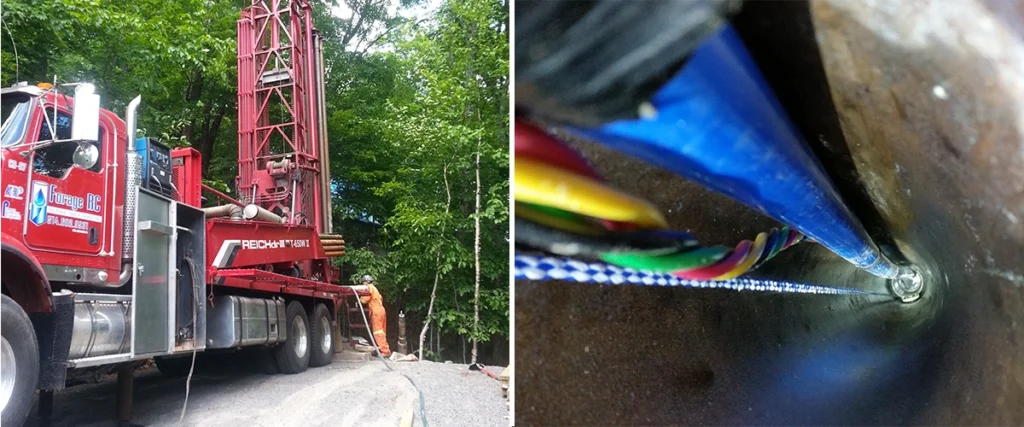
Artesian well installation: a solid solution for peace of mind
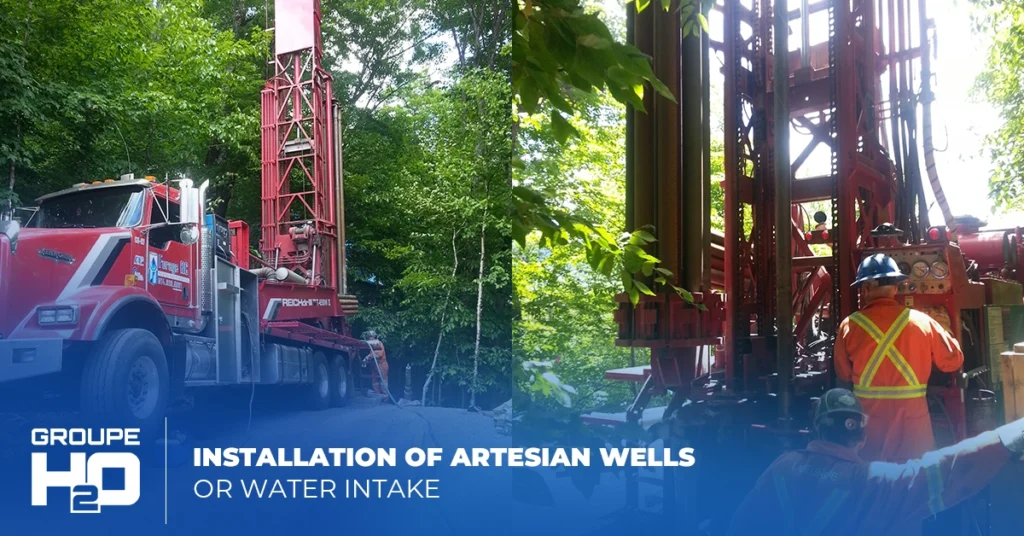
An artesian well often remains the choice that inspires the most confidence when looking for a durable, well-protected solution. It draws water from deeper underground, generally from bedrock, which helps better isolate the source from surface influences.
For many homeowners, it is the most reassuring option when they want to settle in for the long term, enjoy water autonomy, and avoid depending on a more exposed source. In a context like the Laurentians, where properties can vary greatly from one street to another, an artesian well is often the solution considered when seeking a more permanent and robust installation.
What an artesian well provides in practical terms
The main advantage is stability. For a primary residence or a four-season cottage, that can make a real difference. This is an installation that suits people who want to build something serious, without settling for a compromise solution.
An artesian well may also be a better choice when the property is far from a lake or waterway, or when the land is not well suited to a more superficial catchment system. It is often the solution considered when the goal is to invest for the long term.
The point that needs to be looked at realistically
Still, let’s be direct: an artesian well installation represents a significant investment. It is not the most economical solution upfront. To view listed prices based on available options, the best approach is to visit the Groupe H2O store.
In other words, an artesian well can offer a lot of value, but it is not automatically the best option for everyone. It all depends on the land and the project.
Water catchment: a logical option in several cases
When people hear “water catchment,” some immediately think of an inferior solution. That is not accurate. In several areas of the Laurentians, water catchment can be a perfectly coherent answer, especially when a property benefits from natural proximity to a water source or favorable site conditions.
Water catchment can take different forms depending on the reality of the site. It may involve a surface well or drawing water from a lake or waterway, depending on what is possible and relevant for the property.
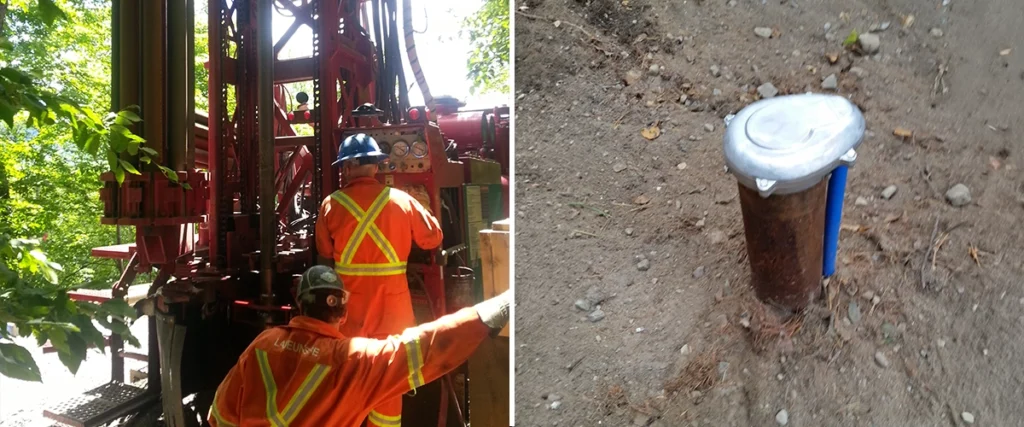
When water catchment becomes interesting
Water catchment can be particularly interesting when the land configuration makes it possible to use an existing source and when the system is properly designed from the start. For a waterfront cottage or a property in an environment where the source is accessible, it can become a practical and logical choice.
It is also an option that appeals to homeowners who want to look at the project from the perspective of the relationship between real needs and investment. To compare listed prices based on the solution being considered, the best approach is to consult the Groupe H2O store directly.
Artesian well or water catchment: the real differences in daily life
On paper, you might think it is enough to compare two columns. In reality, the difference plays out in everyday life.
With an artesian well, many homeowners are mainly looking for peace of mind. They want a solution firmly anchored in the land, designed to last, with a logic of stability and continuity.
With water catchment, the reasoning can be different. Sometimes the goal is to take advantage of the site’s natural configuration, simplify certain aspects of the project, or choose a solution that better fits the immediate reality of the property.
So this is not a battle between a “good” and a “bad” option. It is a question of fit. The right choice is the one that works with the lot, the type of property use, and the homeowner’s expectations.
Real costs and constraints: what to plan for before deciding
This is often where things become more concrete. The real cost of a water project does not depend only on the type of water source chosen. You also need to consider the full job site.
There may be costs or constraints related to property access, excavation, pump installation, pipe routing, integration with the home, water treatment, and future system maintenance. On some properties, logistical complexity can weigh almost as heavily as the type of installation itself.
You also need to think about the administrative side. Depending on the project, municipal procedures and siting rules may come into play. It is not the most exciting part of the file, but it is often the part that prevents unpleasant surprises.
Concrete cases in the Laurentians: everything changes depending on the land
In the Laurentians, there is no universal solution. A lot near a lake in Tremblant does not have the same advantages or constraints as a wooded property in St-Donat or a residential property in Ste-Agathe.
Imagine a four-season cottage surrounded by trees, with tight access and a lot that rises quickly behind the house. In that case, job-site feasibility becomes a major criterion. Conversely, a well-located waterfront property may open the door to another water catchment logic, provided the system is well designed.
That is exactly what makes local support so important. You do not choose your water system the way you choose an appliance. You need to look at the land, the context, and the property’s real use.
Groupe H2O in St-Donat, Ste-Agathe, and Tremblant: a local approach
When you live or build in the Laurentians, you want to speak with a team that understands the territory. Groupe H2O serves areas such as St-Donat, Ste-Agathe, and Tremblant, with on-the-ground knowledge that speaks directly to local property owners.
Here, we are talking about forest homes, family cottages, roads people know by heart, winters that demand reliability, and summers when you simply want to enjoy your property without wondering whether the system will keep up. This proximity changes the quality of the advice. This is not theory. This is concrete.
Why local expertise makes a difference
A water project in the Laurentians is not just about installing equipment. You need to understand soil conditions, topography, access, seasonality, and the homeowners’ lifestyle. Someone who lives there year-round does not have the same needs as someone who uses their cottage only at certain times. Someone who often hosts guests does not have the same expectations as a couple simply looking for a reliable and straightforward solution.
That is why local guidance has real value. It helps avoid generic solutions and focus on what is truly adapted.
So, what should you choose in the end?
If your goal is to aim for a more durable, more anchored, long-term solution, an artesian well often remains a very solid option. If your land, location, or available water source favors another type of catchment, that path can also be entirely relevant.
The real mistake would be choosing too quickly, without analyzing the land and without looking at the project’s actual constraints. In the Laurentians, the right choice is not the one that seems most impressive. It is the one that will be reliable in your daily life, coherent with your property, and reasonable for your budget.
Before going further, the smartest move is to have the situation evaluated concretely. For a property in St-Donat, Ste-Agathe, or Tremblant, Groupe H2O can help guide the choice based on the type of lot, the available water source, and the real needs of the home or cottage.
If you are planning a project, building, or simply evaluating your options, take the time to ask for advice. It is better to make the right choice from the start than to correct a poorly adapted decision later.
FAQ
1. What is the difference between an artesian well and water catchment?
An artesian well generally draws water from deeper underground, while water catchment may depend on a more superficial source or a body of water, depending on the land and the property configuration.
2. Is artesian well installation always the best choice?
No. It is often an excellent solution, but not in every case. The land, access, available source, and budget must all be considered before making a decision.
3. Is water catchment a reliable option for a cottage in the Laurentians?
Yes, in many cases. It all depends on the property, the water source, and the quality of the system design. It is not an option to dismiss automatically.
4. Where can you view prices for the different options at Groupe H2O?
Listed prices can be consulted directly in the Groupe H2O store.
5. Who should you contact to choose between an artesian well and water catchment in St-Donat, Ste-Agathe, or Tremblant?
For a project in the Laurentians, the best approach is to contact Groupe H2O to get advice adapted to the land, the property, and the intended type of use.