Artesian well vs. water intake: when a home or cottage is not connected to a municipal water system, this question quickly becomes essential. In the Laurentians, the right answer rarely depends on a single factor. Property layout, equipment access, the presence of a lake or waterway, the depth required to reach groundwater, and the treatment equipment needed can all influence the decision.
At Groupe H2O, we install artesian wells as well as water intake systems from lakes, rivers, and streams throughout the Laurentians and Lanaudière. Every property has its own characteristics, which is why we assess the project as a whole before recommending a solution.
It is also important to clarify one point: technically, an artesian well is itself a water intake system because it draws groundwater. In this article, we use the term “water intake” specifically to refer to drawing surface water from a lake, river, or stream.
Artesian well vs. water intake: two very different approaches
Imagine a cottage surrounded by forest near Tremblant. The lake is only a few dozen yards away, but the property can also accommodate drilling equipment. At first glance, both solutions may seem possible.
The main difference lies in where the water comes from and in the equipment required to deliver it to the home.
An artesian well draws water from deep underground
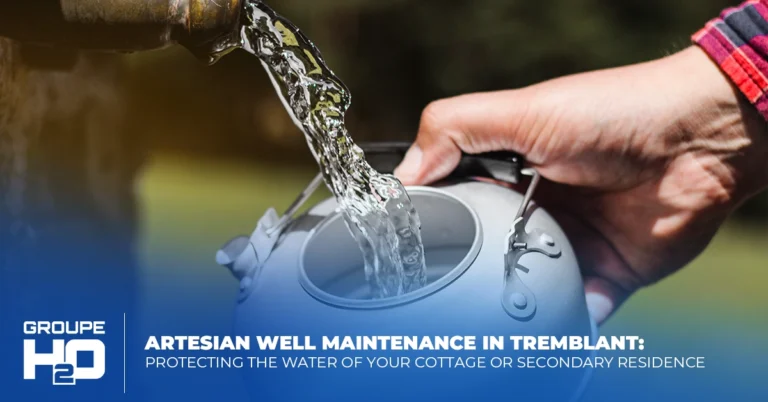
An artesian well draws groundwater from the bedrock. In the Laurentians and Lanaudière areas where we work, wells are generally between 30 and 150 meters deep, or approximately 100 to 500 feet.
A submersible pump is then installed in the well to carry the water to the home and its pressure tank.
This solution involves several factors to consider:
- the water comes from underground rather than from an exposed surface source;
- the required depth varies from one property to another;
- water quality must be tested after drilling;
- a water treatment system may be required depending on test results;
- site access conditions directly affect how the work can be completed.
Deep groundwater is generally less exposed to microorganisms originating directly from the surface. However, this does not mean that it is automatically safe to drink. It may naturally contain various minerals or metals, which is why water testing is important.
A water intake uses a lake, river, or stream
For a property located on a lake or near a waterway, a surface water intake can be another option.
A submersible pump draws the water and carries it to the home through a pipe connected to a pressure tank.
At Groupe H2O, a lake water intake intended to supply a residence is always followed by a water treatment system. Depending on the characteristics of the water, different solutions may be used, including filtration, chlorination, activated carbon, or UV disinfection.
Your property may make the decision for you
In the Laurentians, two properties located only a few miles apart can present completely different challenges.
A flat, easily accessible lot will not require the same preparation as a cottage built on a slope, surrounded by trees, or accessible only by a narrow road.
Before choosing between an artesian well and a water intake, several questions should be considered:
- Can drilling equipment reach the planned location?
- Will a temporary access road need to be built?
- How far is the water source from the home?
- Where is the septic system located?
- Is there a suitable lake, river, or stream nearby?
- What pumping and treatment equipment will be required?
A Groupe H2O project completed in Val-David clearly illustrates the importance of site access. The well location was behind the residence, and there was no side access for the drilling equipment. A pathway therefore had to be created beneath a carport so that a tracked drilling rig could reach the drilling area.
In this specific case, the water obtained after drilling did not require the addition of a water treatment system.
In Saint-Donat, near Lac Blanc, another project also required a tracked drilling rig suited to the terrain. The completed well reached approximately 240 feet deep.
These examples show why a realistic estimate cannot be based solely on property size or the apparent proximity of a lake.
How much does an artesian well really cost?
The price depends mainly on drilling depth, site access, and the work required around the drilling area.
For reference, at Groupe H2O, the median well completed in 2025 was approximately 400 feet deep, and the median price for the well and pump was approximately $25,000.
Additional work or equipment may be required depending on the project, including:
- well sealing;
- supervision of the sealing process;
- the use of specialized equipment;
- hydrofracturing when required;
- excavation and connection to the residence;
- a treatment system if required by the water analysis.
A shallower well with easy access may therefore cost less than a project requiring several additional interventions.
How much does a lake water intake cost?
For a lake water intake, Groupe H2O currently lists an indicative budget of approximately $11,500 plus taxes for the pumping system.
Water treatment must be added to this amount.
As a general indication:
- approximately $3,150 plus taxes to treat clear water;
- approximately $8,395 plus taxes when yellow water requires a more advanced treatment solution.
These amounts are estimates. Water characteristics, pipe length, property configuration, and the work required can all affect the final cost.
The right comparison therefore is not simply between the price of drilling a well and the price of placing a pump in a lake. The entire installation must be considered, all the way to usable water at the tap.
Regulatory requirements are part of the project
Installing a well or another type of water withdrawal system must comply with Quebec regulations as well as applicable municipal requirements.
Before work begins, a permit application must generally be submitted to the municipality concerned.
For a well, certain minimum distances must also be respected in relation to septic systems. Quebec regulations notably require a minimum distance of 15 meters from a watertight system and generally 30 meters from a non-watertight system, with certain exceptions when a well is sealed in accordance with regulatory requirements.
These constraints can directly affect where the well can be installed.
Groupe H2O in St-Donat, Ste-Agathe, and Tremblant: start with your actual property
With our service locations in St-Donat, Ste-Agathe-des-Monts, and Mont-Tremblant, we regularly work with the realities specific to the Laurentians and Lanaudière.
A lakeside cottage, a year-round home in the forest, a new construction without municipal water service, or a difficult-to-access property: the right choice should always be based on the actual conditions of the site.
Case 1: the property provides easy access for drilling
If the drilling rig can reach the property, regulatory distances can be respected, and drilling is feasible, an artesian well is an option worth serious consideration.
Case 2: drilling is particularly difficult
If the property is very difficult to access, installation constraints are significant, or a suitable lake is located directly nearby, a surface water intake may be another option to consider.
Case 3: the property is used year-round
For a primary residence, the entire system must also be considered: water availability, pumping, pressure, treatment, and maintenance.
The decision should therefore be based on the overall reliability of the installation rather than on initial cost alone.
Artesian well or water intake: how do you make the right choice?
Before choosing, we recommend comparing five factors:
- Property access for the drilling rig and other equipment.
- The available water source, whether groundwater or surface water.
- Regulatory requirements, particularly those related to the septic system.
- Water quality and any treatment that may be required.
- The total project cost, not just the main piece of equipment.
At Groupe H2O, we can assess these different factors to determine which solution is best suited to your property.
If you are planning a new construction, purchasing a cottage, or replacing a water supply system in the Laurentians, contact our team in St-Donat, Ste-Agathe, or Tremblant to discuss your project and get advice tailored to your property.
FAQ – Artesian well vs. water intake
1. Does an artesian well always provide drinking water?
No. Well water must be tested. Even when it is clear and odorless, it may contain microorganisms or naturally occurring substances from the ground. In Quebec, regular testing of water from a private well is recommended.
2. Does water from a lake need to be treated?
At Groupe H2O, a lake water intake intended to supply a residence is always paired with a water treatment system. The selected solution depends on the characteristics of the water and may include filtration and disinfection.
3. Which system costs less?
There is no universal answer. A lake water intake may require a lower investment for the pumping system, but water treatment must be added. The cost of an artesian well, meanwhile, depends heavily on drilling depth, site access, and any additional work required.
4. How often should well water be tested?
In Quebec, it is recommended that microbiological parameters be tested at least twice a year. Chemical contaminants should also be tested, particularly when the well is first put into service and according to recommendations based on the results.
5. Can Groupe H2O determine which solution is best for my property?
Yes. We can assess your property configuration, access conditions, available water source, and the equipment required to help guide you toward an appropriate solution. We work with drilling, water intakes, pumps, water analysis, and treatment throughout the Laurentians and Lanaudière.