A hot shower after a chilly day, dishes piling up after a family meal, a load of laundry running while the household gets back into its routine: your water heater works quietly every day. Yet, replacing a water heater before it starts leaking can help prevent many headaches. In Quebec, the age of the tank matters, but it is not the only factor to watch. Its condition, water quality and your home insurance requirements should also be part of your decision.
At Groupe H2O, we work every day with water and the equipment used to supply, treat and distribute it in residential and commercial properties. In the Laurentians, where homes, cottages and properties supplied by private wells are part of the landscape, taking care of your water system is a practical preventive measure.
When should you replace a water heater in Quebec?
There is no single age at which every water heater must automatically be replaced.
CAA-Quebec indicates that a water heater generally has a lifespan of 10 to 15 years, depending on the manufacturer. The organization also notes that insurers often impose their own criteria and generally require replacement after 10 or 12 years.
The first thing to do is therefore very simple: check the age of your unit.
The rating plate attached to the tank usually shows its manufacturing date. If your water heater is approaching the limit recommended by its manufacturer or the limit specified in your home insurance policy, it is best to get informed before a problem occurs.
A water heater can still produce hot water even when it is approaching the end of its useful life.
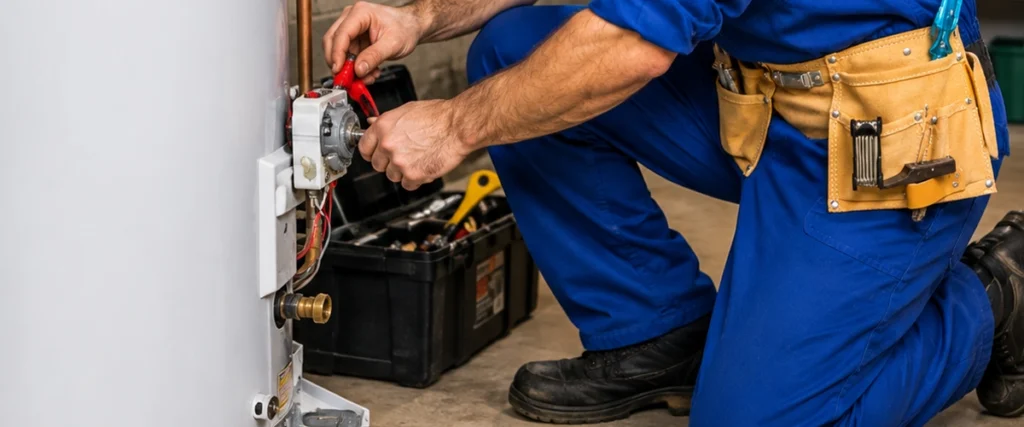
Why should home insurance factor into your decision?
The apparent condition of the water heater is not the only consideration.
CAA-Quebec notes that insurance coverage may be affected when a water heater exceeds the maximum age accepted under the policy. Since requirements vary from one insurer to another, it is important to check the specific terms of your home insurance policy.
In other words, do not rely solely on a rule you may have heard from someone else. Check the year your unit was manufactured, then review the requirements that actually apply to your property.
Signs that it may be time to take action
Fall is a good time to inspect your home’s equipment before the cold season arrives. When you head down to the basement or utility room, take a few minutes to look at your water heater.
Some signs deserve particular attention:
- the water is not as hot as it used to be, or the hot water supply runs out more quickly;
- the water has a slight reddish tint;
- rust appears around the base of the tank;
- moisture or water droplets are visible around the tank.
These are among the main signs of an aging water heater identified by CAA-Quebec.
A drop in performance does not automatically mean the tank needs to be replaced immediately. Some issues may have another cause. An inspection can help distinguish between a repairable problem and a unit that is truly approaching the end of its useful life.
However, water around the tank or visible corrosion should be addressed quickly.
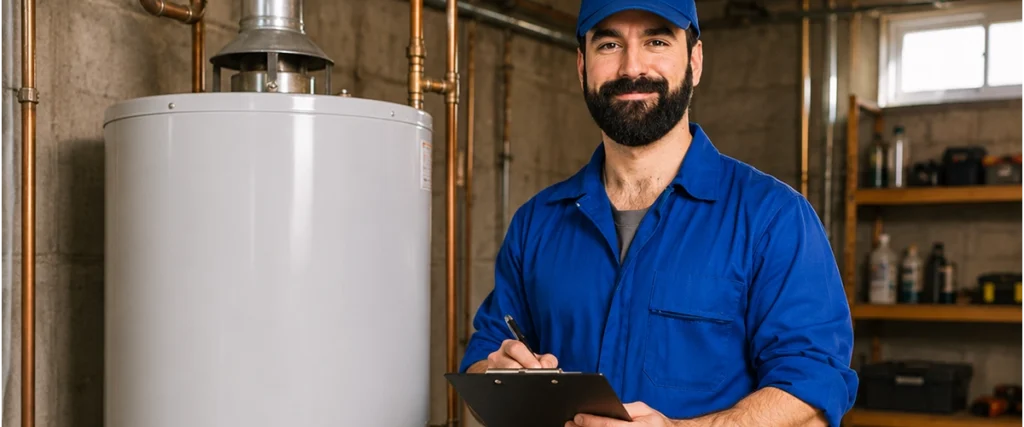
Should you wait until a water heater leaks before replacing it?
No.
You do not need to wait for a leak before considering replacing a water heater. When a unit is approaching the end of its expected lifespan, planning the replacement ahead of time can help you avoid having to make a decision in an emergency.
Imagine a tank starting to leak one evening when your basement is finished, boxes are stored nearby or you are regularly away from the property. Even a relatively straightforward situation can quickly become far more inconvenient.
Prevention therefore means considering several factors together: the age of the unit, the condition of the tank, the manufacturer’s recommendations and the insurer’s requirements.
Hard water: how can it affect your water heater?
In our line of work, we know that water quality also deserves a place in the discussion.
CAA-Quebec notes that in areas with hard water, a water heater’s sacrificial anode can dissolve more quickly. This component plays an important role by helping protect the tank against corrosion. The organization also indicates that scale can build up more quickly when the water is hard or comes from a well.
This does not mean that hard water will automatically shorten the lifespan of your water heater. Several factors determine the actual condition of the unit.
However, it is useful to understand the characteristics of the water flowing through your home, especially when the property is supplied by a private well.
What should you check if you have hard water?
When water contains a high concentration of hardness-causing minerals, it is useful to consider the entire water system.
Some factors to look at include:
- the actual hardness level of the water;
- the presence of scale deposits;
- the condition and maintenance of the water heater;
- the water treatment system already in place;
- the property’s water source.
CAA-Quebec also recommends periodic cleaning when the water is hard or comes from a well to help prevent certain problems and maintain water heater performance.
Replacing a water heater: take the opportunity to choose the right capacity
Replacement is also a good opportunity to make sure the tank capacity still matches your needs.
A home that once had one or two occupants may now house a family. Conversely, your needs may have decreased. The number of showers taken one after another, baths and the simultaneous use of certain appliances all affect how much hot water you need.
CAA-Quebec recommends choosing capacity primarily based on the number of occupants and their hot water usage habits.
A water heater that is too small may regularly run out of hot water. An unnecessarily large tank, on the other hand, can result in greater standby heat loss.
Replacing a water heater should therefore not automatically mean buying the exact same capacity as the old unit. It is better to reassess your household’s current needs.
An installation that must comply with Quebec requirements
Replacing a storage water heater must also be done in accordance with applicable requirements.
The Régie du bâtiment du Québec specifies that replacing a storage water heater in an existing building must comply with the provisions of Section 2.6.1.7 of Chapter III, Plumbing, of the Construction Code. Requirements include provisions related to the discharge piping for the temperature and pressure relief valve.
So it is not only about choosing a new tank: the installation itself must also be done properly.
For an electric water heater, CAA-Quebec also notes that the electrical connection must be performed by a certified electrician.
Groupe H2O in St-Donat, Ste-Agathe and Tremblant: looking at your entire water system
In the areas of St-Donat, Ste-Agathe and Tremblant, water-related conditions can vary significantly from one property to another. One home may be connected to a municipal water system, while another may rely on a private well and pumping system.
At Groupe H2O, our expertise includes plumbing, water treatment and filtration, pumps and wells. Our services address both residential and commercial needs in rural and urban settings.
This broader perspective is particularly useful when looking at your water heater. Rather than focusing only on the tank, it can also be worthwhile to understand the water that supplies it.
Hard water? A property supplied by a private well? Mineral deposits that keep coming back? These are all factors worth considering when planning the maintenance of your equipment.
September: a good time to check your water heater
As cooler days return to the Laurentians, September naturally becomes a time when many homeowners start thinking about their home’s equipment before winter.
Take the opportunity to have a look at your water heater.
Find its manufacturing date. Look around the base. Check for moisture or signs of corrosion. Pay attention to any unusual decrease in your hot water supply. Also review your insurance policy to determine the age requirements that apply.
A few minutes can be enough to determine whether the issue can wait or deserves a closer look.
Know your water better to better protect your equipment
Replacing a water heater at the right time ultimately depends on a combination of factors rather than a single number.
Age is an excellent starting point, but the condition of the tank, insurance requirements, household needs and water quality should also be taken into account.
At Groupe H2O, we can help you better understand your water system and identify solutions suited to your property. Whether you are in St-Donat, Ste-Agathe, Tremblant or elsewhere in the region, you can contact our team for information and personalized advice regarding your plumbing, pumping and water treatment needs.
FAQ – Replacing a Water Heater
At what age should a water heater be replaced?
CAA-Quebec indicates that a water heater generally has a lifespan of 10 to 15 years, depending on the manufacturer. Your insurer may require replacement sooner, often around 10 or 12 years. You should therefore check both the unit’s rating plate and your insurance policy.
How can I tell how old my water heater is?
The manufacturing date can usually be identified from the rating plate attached to the tank. CAA-Quebec recommends checking it to determine the age of the unit.
What are the signs that a water heater needs to be replaced?
A decrease in the amount of available hot water, slightly reddish water, rust around the base of the tank, and moisture or water droplets around the tank are among the signs to watch for.
Can hard water affect a water heater?
Yes. According to CAA-Quebec, the sacrificial anode can deteriorate more quickly in hard water, and scale can also build up more rapidly. Maintenance adapted to your water quality may therefore be beneficial.
Can Groupe H2O help me assess the water quality at my property?
Groupe H2O offers services related to water treatment and filtration, plumbing, pumps and wells. For a specific situation in St-Donat, Ste-Agathe or the Tremblant area, contact our team for advice tailored to your installation.