When you turn on the faucet in a home, cottage or secondary residence, you expect clear, fresh and reassuring water. Yet artesian well maintenance should never be postponed simply because the water looks fine. In Quebec, a private well requires regular monitoring, especially in vacation-home areas like Tremblant, St-Donat and Ste-Agathe, where properties are sometimes occupied part-time, closed for part of the year or exposed to major seasonal changes.
At Groupe H2O, we know that a well is not just a technical installation. It supplies the morning coffee, the shower after a day outside, family meals, weekends at the cottage and everyday peace of mind. It is also an important responsibility: making sure the water entering your home remains safe, stable and suitable for your family’s needs.
Artesian well maintenance: why frequency truly matters
A well can operate properly for a long time without showing any obvious signs of a problem. That is exactly what makes inaction risky. Water can be clear, with no particular odor, and still contain contaminants that are invisible to the naked eye.
Water testing is therefore a preventive reflex, not just a reaction when something goes wrong. For microbiological parameters, it is recommended to have the water tested at least twice a year, ideally in spring and fall. These periods are important because thawing, heavy rain and water movement in the soil can increase the risk of contamination.
For chemical contaminants related to soil characteristics, a complete analysis should also be performed at least once during the period of well use. Depending on the results, more regular follow-up may be needed.
In practice, testing should also be planned in certain specific situations:
- after flooding or a major event around the property;
- after excavation, blasting or tree-clearing work nearby;
- after well disinfection;
- after the installation of a water treatment system;
- when the taste, odor, color or flow of the water changes;
- when purchasing a property supplied by a private well.

The health risks of inaction
The main risk with a poorly monitored well is consuming water whose true quality is unknown. Microbiological contaminants such as E. coli, fecal coliforms or enterococci may indicate fecal contamination. Other contaminants, such as arsenic, manganese, nitrates, nitrites, iron or fluoride, may also be present depending on the area, soil type and immediate environment.
You should not wait until the water tastes bad before taking action. Problematic water does not always appear with an unusual odor, color or texture. That is why a regular testing routine is more reliable than a simple impression.
Inaction can also make the problem harder to correct. The earlier an issue is detected, the easier it is to identify the right solutions: disinfection, UV treatment, filtration, repair, pump adjustment or a more detailed inspection.
Secondary residences in Tremblant: the well that is too easily forgotten
In a secondary residence in Tremblant or the Laurentians, the well can go several weeks without being top of mind. You arrive on Friday evening, turn on the lights, heat the cottage, prepare dinner, then use the water as if everything were automatically normal.
But a property that is used less often actually deserves special attention. Between snow, freezing, thawing, heavy rain, leaves, gravel roads, nearby septic systems and work around the property, a well’s environment can change without the owner noticing right away.
Before peak cottage season, before summer vacation or before a long period of occupancy, it is wise to check the water quality and make sure the equipment is working properly. It is a small step that can prevent a peaceful weekend from turning into a headache.
Groupe H2O in St-Donat, Ste-Agathe and Tremblant: a team close to your water
With service points in St-Donat, Ste-Agathe and Tremblant, Groupe H2O supports owners of primary residences, cottages and commercial buildings with many water-related needs: testing, treatment, filtration, pumps, wells and specialized plumbing.
Our approach is simple: understand your situation before recommending a solution. An artesian well, a surface well, an aging pump, a UV system, a water softener or a suitable filtration system do not all meet the same need. The right diagnosis always starts with the right questions and, very often, with a reliable water analysis.
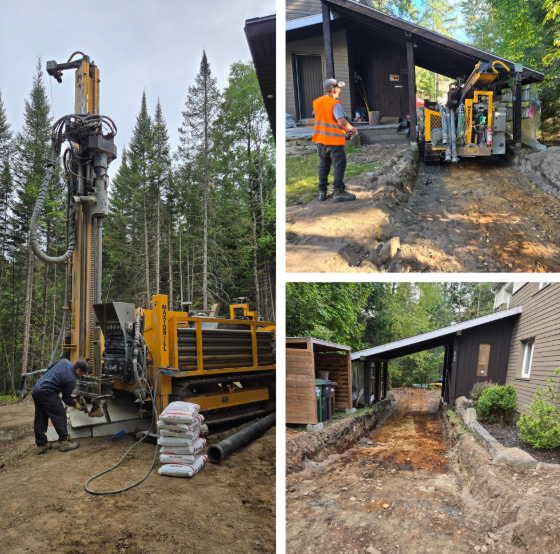
For artesian wells, Groupe H2O offers disinfection and hydrofracturing cleaning when water flow becomes insufficient. For surface wells, disinfection and repair solutions may also be considered depending on the condition of the installation.
Simple checklist for well owners
Here is a clear routine to keep on hand.
Twice a year
- Have microbiological parameters tested.
- Choose spring and fall whenever possible.
- Keep the results to compare changes over time.
Once during the period of well use
- Have physico-chemical parameters tested.
- Check for contaminants related to the soil and area.
- Ask for advice if a contaminant appears at a high concentration.
Whenever there is a visible change
- Note any unusual odor.
- Watch for cloudy, colored or staining water.
- Check for changes in pressure or flow.
- Do not ignore a metallic, earthy or sulfur-like taste.
After a specific event
- Have the water tested again after flooding.
- Check the water after major work near the property.
- Test the water after disinfection.
- Confirm that a new treatment system is working properly.
For a cottage or secondary residence
- Plan testing before a long period of use.
- Check the pump and pressure before family or guests arrive.
- Keep the contact information of a local specialist close at hand.
- Act quickly if the water seems different from the previous season.
When should a well be disinfected?
Disinfection may be necessary when testing reveals the presence of microbes, when contamination is suspected or as part of a maintenance routine recommended for the situation. For an artesian well, this operation must be carried out properly, with the right dosages, the right waiting times and follow-up testing after the intervention.
At Groupe H2O, well disinfection is accompanied by testing to verify that the intervention has worked. If bacteria persist, an adapted treatment solution, such as a UV disinfection system, may be considered.
Do not wait until the problem becomes urgent
A poorly maintained well can quickly become a source of concern. No pressure. Questionable water. Non-compliant test results. A cottage unusable for the weekend. A property visit delayed. A family without reliable drinking water.
The goal is not to dramatize. The goal is to prevent. With a simple routine, an owner can stay in control: test, monitor, document, correct at the right time and ask for advice before the situation becomes more complicated.
Well-monitored water means a calmer home, a more welcoming cottage and a better-protected family.
FAQ
How often should artesian well water be tested?
Microbiological parameters should be tested at least twice a year, ideally in spring and fall. Physico-chemical parameters should be tested at least once during the period of well use, with follow-up adapted according to the results.
Does clear water mean it is drinkable?
No. Water can be clear, with no odor or particular taste, while still containing invisible contaminants. Only water testing can verify its real quality.
When should an artesian well be disinfected?
Disinfection may be necessary when testing reveals the presence of microbes, after certain work, after suspected contamination or as part of recommended maintenance depending on the well’s situation.
What should be monitored in a secondary residence in Tremblant?
You should monitor water quality before long periods of use, changes in odor, taste, color, pressure or flow, as well as the possible impacts of thawing, heavy rain or nearby work.
Can Groupe H2O help with well maintenance?
Yes. We support owners with water testing, water treatment, pumps, maintenance, repair and well disinfection in St-Donat, Ste-Agathe, Tremblant and the surrounding areas of Quebec.